Knowing how to do accounting for small business does not mean you need to become an accountant. It means building a repeatable way to capture financial activity, check that your records match reality, and use the results to make decisions. A steady process also makes tax preparation less stressful because the information is organized before deadlines arrive.
Talk with an accounting professional
What does small business accounting include?
Accounting is the process of turning business activity into reliable financial information. Bookkeeping is a key part of it: transactions are recorded, categorized, and supported with documents. Accounting also involves checking those records, preparing reports, and using the information to understand the business.
A basic system should answer practical questions: How much cash is available? What income and expenses occurred? Who owes the business money, and what bills are due? Are payroll, sales tax, and other obligations being tracked? Are the numbers complete enough to support a tax return?
The details vary by business structure, industry, and the way a business earns revenue. A freelancer with a few clients may have fewer transaction types than a retailer managing inventory, sales tax, and multiple payment channels. The aim is not to make every business use the same chart or software. It is to create records that are complete, understandable, and maintained on time.
How do you set up a reliable accounting foundation?
1. Separate business and personal activity
Use business accounts for business income and spending, and personal accounts for personal activity. Mixing the two makes it harder to identify business transactions and explain them later. If an owner pays a business cost personally, record the payment clearly and retain its receipt rather than leaving it unexplained in a personal account.
Keep a consistent process for transferring money between the business and its owner. The correct accounting treatment depends on the entity and circumstances, so do not label every transfer as an expense. Record what happened and ask a qualified tax professional how it should be classified when you are unsure.
2. Choose a method and recordkeeping tool
Many small businesses use accounting software to record income and expenses, connect accounts, and produce reports. Some begin with a simpler ledger. Whatever the tool, it should fit the volume and kinds of activity, allow records to be reviewed, and support secure access and backups.
Choose a consistent accounting method with professional guidance when needed. Cash-basis and accrual-basis records recognize income and expenses differently. The method used can affect tax reporting and financial comparisons. Do not switch methods casually or assume that a software setting alone settles what is appropriate for your business.
3. Create sensible categories
A chart of accounts groups transactions into categories such as income, operating expenses, assets, liabilities, and equity. Start with categories that reflect how the business actually operates. Too few categories hide useful detail; too many create unnecessary work and inconsistent coding.
Use a written rule for recurring or ambiguous items. For example, decide how to classify payment processing fees, software subscriptions, owner contributions, and loan payments. A loan payment is not all an expense: principal reduces the liability, while interest is generally recorded separately. Specific tax treatment depends on the facts, so avoid guessing based only on the bank description.
How should you organize transactions and documents?
Capture activity close to when it happens
Record sales, customer payments, vendor bills, purchases, bank charges, loan activity, and owner transactions regularly. Waiting until tax season increases the chance that a transaction will be forgotten or misclassified. A weekly review is often easier to manage than a year-end pile of statements.
Save source documents that explain transactions. Useful records can include sales invoices, receipts, vendor bills, deposit details, loan statements, payroll reports, and tax notices. Keep digital copies in a secure, consistently named folder or document system. A record should make it possible to understand what was purchased, when, for what business purpose, and how it was paid.
Match income to its source
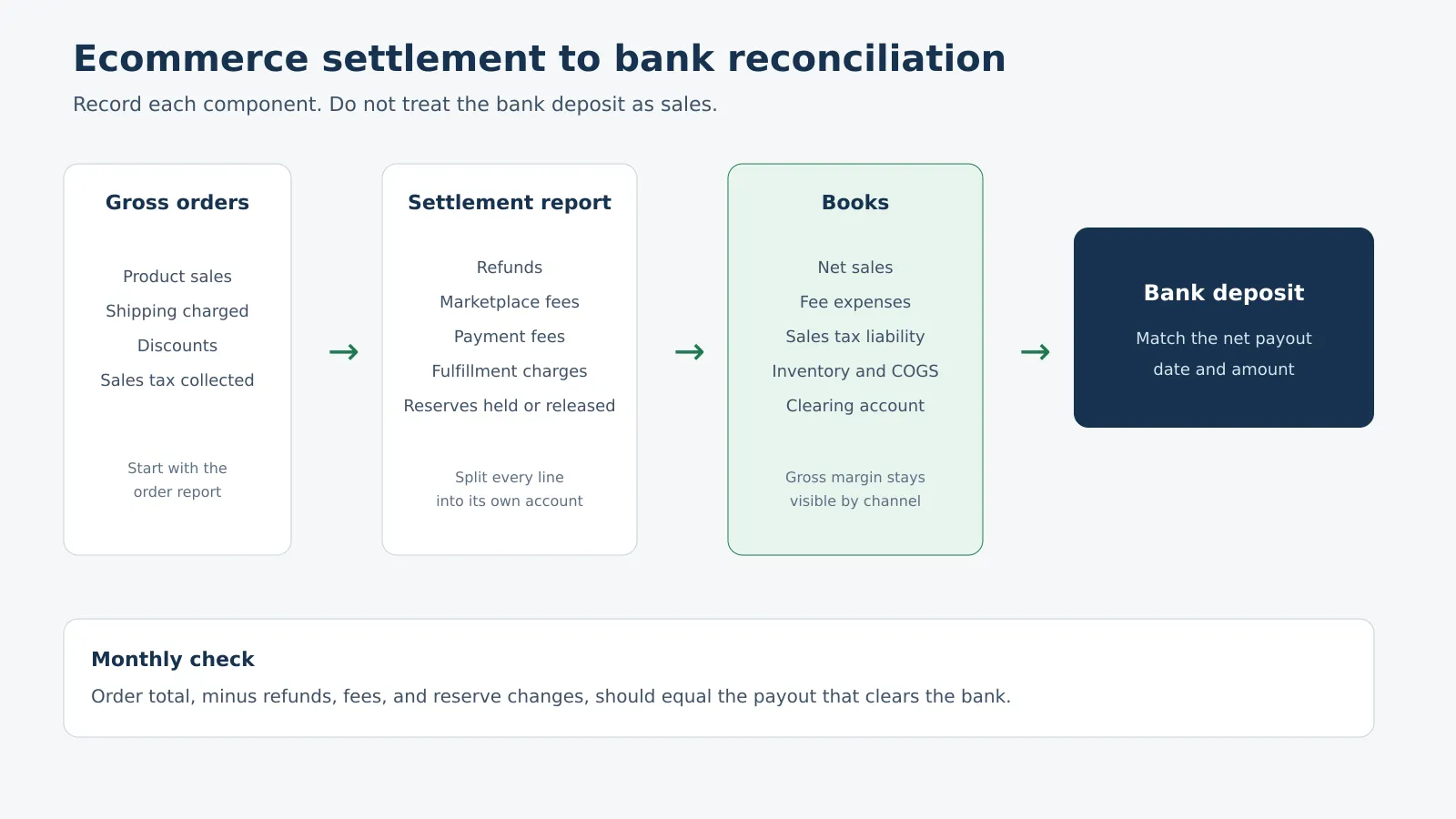
Sales may arrive through checks, card processors, online platforms, cash, or bank transfers. Record the gross sale and account for fees or refunds separately where appropriate. A processor deposit may be smaller than the sales total because fees, refunds, or reserves were withheld. Treating the deposit itself as the full sale can distort both income and expenses.
For customer invoices, track what has been billed and what has been collected. For cash-basis records, timing rules differ from accrual records, but invoices and payment details still help explain the business activity. Keep a list of overdue customer balances and follow up using a consistent process.
Keep bills and payment evidence together
Record bills when received and note when they are paid. A vendor bill and the bank payment are related but are not necessarily two expenses. If your records count both as expenses, costs may be overstated. Keep the invoice, payment confirmation, and any credit or refund documentation together or linked in the bookkeeping system.
For recurring costs, review the amount and vendor periodically. This can reveal duplicate subscriptions or a change that needs explanation. Do not treat a business purchase as deductible merely because it was paid from a business account. Business purpose and applicable tax rules matter.
How do you reconcile accounts?
Reconciliation compares your accounting records with statements from banks, credit cards, lenders, and other financial accounts. The goal is to confirm that recorded activity agrees with the external record and to investigate differences. A feed of imported transactions is not a substitute for reconciliation: imports can be duplicated, omitted, or categorized incorrectly.
- Gather the statement. Use the statement for the period being closed, including all pages and any transaction detail.
- Confirm opening and ending balances. Check that the period and account in the bookkeeping system match the statement.
- Match each transaction. Compare deposits, withdrawals, fees, transfers, and payments. Mark items only when the amount and date make sense.
- Investigate unmatched items. Look for timing differences, duplicates, missing entries, incorrect amounts, or transactions posted to the wrong account.
- Resolve and document the difference. Make supported corrections, then save the reconciliation report and relevant explanation.
Do not force a reconciliation to zero with an unexplained adjustment. A difference can be a clue: a payment may have been entered twice, a bank charge may be missing, or a transfer may have been recorded as income. If a discrepancy cannot be explained, leave a note and investigate it rather than hiding it.
Reconcile each account at least monthly when statements are available. Reviewing more often can help businesses with frequent transactions or tighter cash needs. The important point is to finish each period before the records become difficult to trace.
What does a practical monthly close look like?
A monthly close is a short, repeatable review that makes each month easier to understand. Put the steps on a calendar and assign responsibility. If more than one person handles transactions, define who gathers documents, who reviews coding, and who approves payments.
- Collect bank, credit card, loan, processor, and payroll statements.
- Record sales, customer receipts, bills, purchases, fees, transfers, and adjustments with supporting documents.
- Review uncategorized transactions and ask for missing details before assumptions become permanent.
- Reconcile every relevant cash and credit account to its statement.
- Review accounts receivable, unpaid bills, loans, and owner activity for unusual balances.
- Check payroll and applicable tax records against reports and filing confirmations.
- Produce the month’s financial reports, compare them with prior periods, and note questions.
- Save a dated close packet so the next review and tax preparation have a clear starting point.
When the business has employees, payroll records need their own attention. Keep payroll summaries, tax deposits, and filing records organized. Accountants Now processes payroll through ADP, including payroll taxes and W-2s. For an overview of the service, see payroll services.
Which reports should you review?
Financial statements help turn transaction records into a view of business performance and position. A profit and loss statement summarizes income and expenses over a period. A balance sheet shows assets, liabilities, and equity at a point in time. A cash flow view helps explain how cash moved. Each report answers a different question, and none should be interpreted without checking that the underlying records are current.
| Report | What it shows | Questions to ask |
|---|---|---|
| Profit and loss | Income and expenses across a selected period | Which categories changed? Are unusual items documented? |
| Balance sheet | Assets, liabilities, and equity at a specific date | Do cash, loans, and customer balances agree with supporting records? |
| Cash flow review | Cash received and spent, including financing and transfers | Can the business meet expected bills and payroll? |
| Accounts receivable and payable detail | Customer balances due and bills awaiting payment | Are overdue items valid, and are upcoming obligations planned for? |
Compare the current month with prior months and, when useful, the same period in the prior year. Investigate large changes instead of assuming they are correct or incorrect. A drop in cash might reflect a planned equipment purchase, late customer payments, or an unrecorded transaction. Reports help identify questions; they do not answer every question by themselves.
For small businesses, financial statements are part of Accountants Now’s monthly bookkeeping service. Learn about small business bookkeeping and the records it can help organize.
How do you connect accounting records to tax preparation?
Tax preparation is easier when the books are maintained throughout the year. Keep business income and expense records, asset purchase details, loan information, payroll reports, and prior tax filings in an organized place. Flag unusual events, such as a major asset purchase, a change in ownership, or a new revenue stream, for review rather than waiting until the return is due.
Bookkeeping reports are not automatically a finished tax return. Tax rules may require adjustments, and the treatment can depend on entity type and individual facts. Keep a list of questions and provide requested documentation to the preparer. The IRS provides general guidance and forms through its official website; use current IRS material for federal filing requirements and consult a tax professional about how rules apply to your circumstances.
Accountants Now offers business tax return preparation. Business tax preparation and filing are included with its monthly bookkeeping subscriptions, according to the firm’s service information. A clear monthly close gives the tax preparer a more useful starting point, but it does not replace reviewing the return’s specific requirements.
Common accounting mistakes to catch early
- Mixing personal and business spending: Separate accounts where possible and document exceptions with a clear description.
- Recording only deposits: Deposits may be net of fees, refunds, or other adjustments. Reconcile them to sales and processor reports.
- Duplicating expenses: Match bills to payments so the same cost is not recorded twice.
- Leaving transactions uncategorized: Resolve questions promptly and keep explanations with the records.
- Skipping reconciliations: A bank balance alone does not prove that the ledger is complete or accurate.
- Ignoring balance sheet accounts: Review loans, customer balances, credit cards, and owner activity, not just profit and loss.
- Using reports without checking their date range: Confirm the period and accounting method before comparing totals.
- Waiting until filing season: Regular reviews make missing documents easier to find while the details are still fresh.
If an error is found, document what happened and correct the accounting records using supporting evidence. If it affects a filed return or a compliance deadline, get professional advice before deciding whether an amended filing or other action is needed.
Beyond the basics: make the system fit the business
Once the core routine works, tailor it to the decisions the owner needs to make. A contractor may want to review costs by project. A service business may track revenue by service line. A retailer may need more detailed inventory records. Add useful detail only when the business can maintain it consistently and the reports will inform a real decision.
Set review thresholds for items that deserve attention. For example, identify transactions above a chosen amount that require a receipt and explanation, or flag a category whose month-to-month change needs review. These are internal controls, not tax rules. The thresholds should suit the business and should not replace the review of every statement.
Also protect the records. Limit access to people who need it, use secure systems, and retain backups. Accountants Now states that client information is confidential and is never sold to third parties. Review the firm’s privacy policy for its published details.
As the business grows, review whether the accounting method, categories, and close schedule still fit. More employees, locations, sales channels, or financing can increase the volume and complexity of records. A process that worked for a solo freelancer may need additional review and clearer responsibilities once other people handle money or transactions.
When should you get professional accounting support?
Outside help may be useful when records repeatedly fall behind, reconciliations do not balance, reports are hard to interpret, tax obligations are unclear, or the owner spends too much time maintaining the system. Support can also help establish a routine when the business is changing or when financial information is needed for planning.
Before choosing a provider, ask who will work with you, how records and questions will be exchanged, what the service includes, and how pricing is determined. Clarify whether bookkeeping, financial statements, payroll, and business tax preparation are separate or bundled. Request an explanation in plain language, and make sure responsibilities and deadlines are understood.
Accountants Now describes a dedicated in-house team of five accountants per client, with multiple communication options including iMessage, video chat, and a secure portal. Its services include bookkeeping, payroll, business and personal tax returns, and IRS debt negotiation. The firm serves small and mid-size businesses, freelancers, and individuals, including clients in Broward County, Palm Beach County, Orlando, and Tampa. Details and fit depend on the service you need.
For more context on how ongoing support fits into a business, read about business accounting services. You can also review the firm’s frequently asked questions before discussing your situation.
Frequently asked questions
Can I do my own small business accounting?
Many owners maintain their own records, especially when transaction volume and complexity are manageable. The essential work is consistent documentation, accurate categorization, regular reconciliation, and review of reports. Get help when you are unsure about tax treatment, compliance obligations, or unexplained differences.
How often should I update my books?
Record activity regularly, ideally on a weekly schedule that matches the business’s volume. Reconcile accounts monthly using completed statements, then review reports after the period is closed. Businesses with frequent transactions or tighter cash needs may benefit from more frequent checks.
What records should I keep for business transactions?
Keep statements, invoices, receipts, payment evidence, processor reports, payroll records, loan documents, and tax filings relevant to the activity. The record should explain the amount, date, business purpose, and payment method. Retention periods vary by record and circumstance, so consult current IRS guidance or a tax professional for your situation.
Is accounting software enough?
Software can help record transactions and produce reports, but it cannot ensure that every transaction is correctly categorized or that imported activity is complete. Human review, reconciliation, and documentation remain important. Software should support the process rather than replace it.
What is the difference between bookkeeping and accounting?
Bookkeeping focuses on recording and organizing financial activity. Accounting includes interpreting and reviewing those records, preparing financial information, and considering reporting or tax implications. In practice, the terms can overlap, so confirm exactly what a provider’s service includes.
Discuss your business accounting needs
A consistent routine turns scattered transactions into records you can use. Start with organized documents, reconcile every account, and review the reports each month so you can address questions before they become bigger problems.