November 17, 2026

Bookkeeping for Ecommerce Businesses: A Practical Guide

Bookkeeping for Ecommerce Businesses: A Practical Guide

Running an ecommerce business means money moves through several systems before it reaches your bank account. A customer may pay through your website, a marketplace may deduct fees and refunds, a payment processor may hold a reserve, and your bank may show one combined deposit. If those pieces are not connected, it becomes difficult to know what you sold, what you actually earned, how much inventory you have, and whether your tax records are ready.

Get Your Instant Bookkeeping Quote

This guide to bookkeeping for ecommerce businesses explains the practical system owners can use to organize sales, payouts, inventory, expenses, and monthly reporting. It is designed for online retailers selling through a website, marketplace, social commerce channel, or several platforms at once. A dedicated team can maintain that system for you. Small business bookkeeping from Accountants Now includes monthly reporting. Business tax filing comes with the subscription.

The Core System for Ecommerce Bookkeeping

Ecommerce bookkeeping is more than recording deposits. The books should explain how gross sales became net revenue, how inventory became cost of goods sold, and how operating expenses affected profit. A reliable system usually has five connected parts:

  • Sales records: Orders, discounts, returns, refunds, shipping charges, and sales tax collected.
  • Settlement records: Marketplace and processor statements showing fees, reserves, chargebacks, and the amount paid out.
  • Inventory records: Units purchased, units sold, freight, storage, damaged goods, and remaining stock.
  • Expense records: Advertising, software, packaging, merchant fees, contractors, rent, and other costs.
  • Reconciliations and reports: Checks that connect platform activity to bank activity and produce useful monthly financial statements.

The goal is not to make every platform look identical. The goal is to create consistent categories and a repeatable process so that each channel can be reviewed on its own and then combined in the general ledger.

Why Bookkeeping for Ecommerce Businesses Does Not Match the Bank

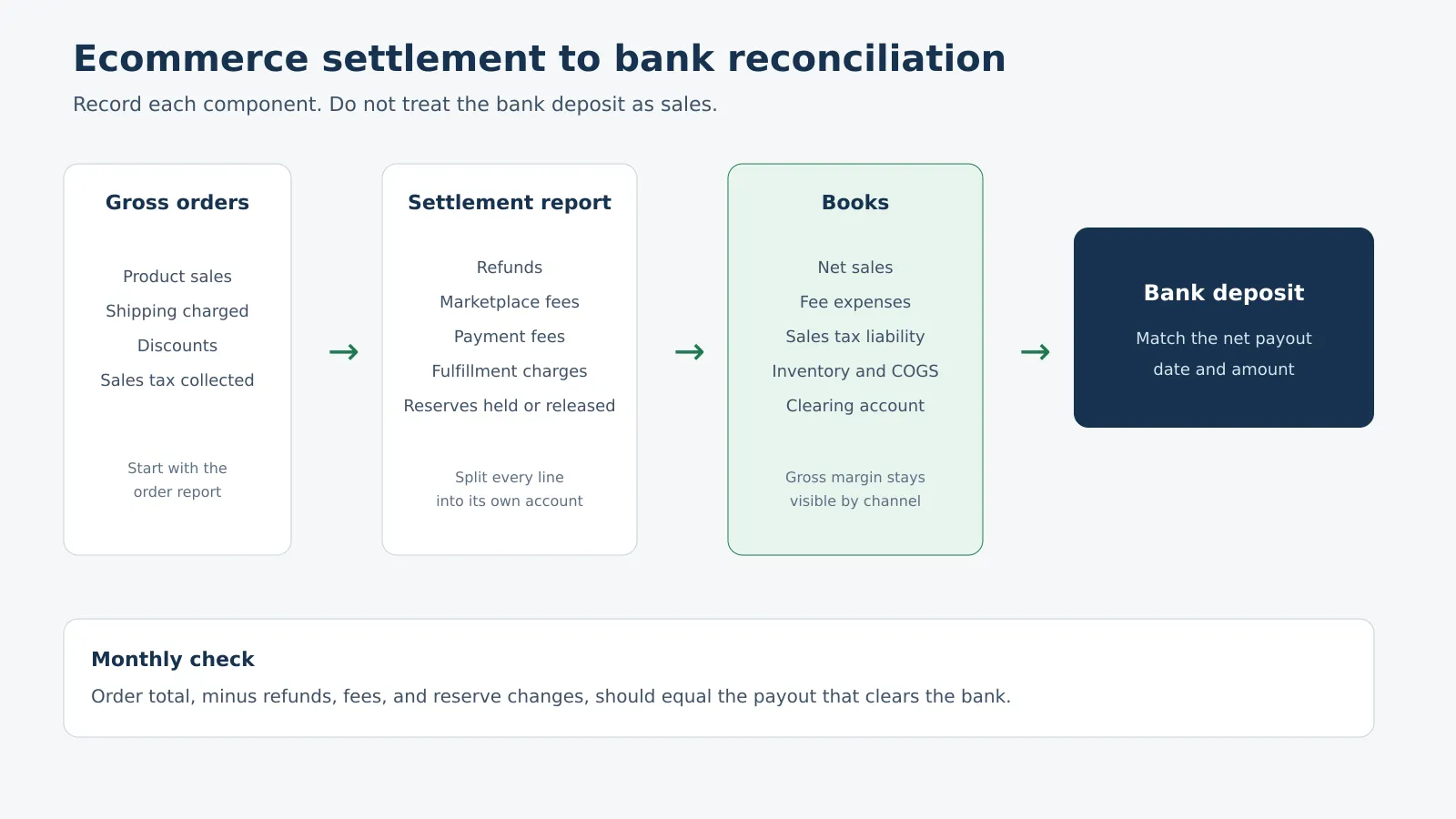
A common mistake is to treat every bank deposit as sales income. A payout may represent several days of orders, less marketplace commissions, payment processing fees, refunds, shipping adjustments, and a reserve. A deposit can therefore be lower than the sales reported by the storefront without anything being wrong.

For each sales channel, save the settlement report for the period and record the components separately. A basic reconciliation should answer these questions:

  1. What was the gross order value during the settlement period?
  2. Which discounts, returns, refunds, and chargebacks reduced the amount?
  3. Which platform, payment, fulfillment, or advertising fees were withheld?
  4. Was money placed into or released from a reserve?
  5. What net amount was transferred to the bank, and when did it arrive?

This approach prevents understated revenue and gives the owner a clearer view of channel profitability. It also makes it easier to identify a missing payout, duplicate import, unexpected fee, or timing difference before the problem grows.

Track Each Ecommerce Sales Channel Separately

If you sell on your own website and marketplaces, one combined “online sales” account may hide important information. Use separate channel categories or classes for the website, Amazon, Etsy, social commerce, wholesale, or other material sources. The exact chart of accounts depends on the business, but the reporting principle is simple: the owner should be able to compare sales, fees, refunds, and contribution by channel.

Channel-level tracking helps answer practical questions:

  • Which channel produces the highest gross sales?
  • Which channel has the largest fee burden?
  • Where are refunds or chargebacks increasing?
  • Does a promotion create profitable demand or only reduce margin?
  • Is a marketplace worth the time and fulfillment complexity it adds?

Accountants Now has also published platform-specific guidance, including bookkeeping tips for Amazon sellers and bookkeeping tips for Etsy sellers. Those resources can supplement a broader ecommerce process without replacing channel reconciliation.

Inventory, Cost of Goods Sold, and Gross Margin

Revenue alone does not show whether an ecommerce business is profitable. The business also needs a reasonable way to track the cost of the products sold. Cost of goods sold, often called COGS, generally reflects the cost assigned to inventory that was sold during the period. Remaining inventory is not the same as an expense just because it was purchased.

Depending on the operation, product cost may include the purchase price and certain costs needed to bring inventory to its saleable location. Freight, customs, packaging, storage, and fulfillment treatment should be reviewed with the business’s accountant because the correct treatment can vary by facts and accounting method.

At minimum, maintain records that show:

RecordWhy it mattersUseful review question
Units purchasedSupports inventory quantities and product costDo purchases agree with vendor bills and receiving records?
Units soldConnects orders to inventory movementDo channel reports match the products shipped?
Returns and damaged goodsExplains stock and margin changesAre returned units resalable, written off, or awaiting inspection?
Freight and fulfillmentShows the cost of getting orders ready and deliveredAre these costs tracked consistently by product or channel?
Ending inventorySupports the balance sheet and future COGS calculationsDoes a physical or system count support the reported balance?

Gross margin is a particularly useful ecommerce metric. It compares sales after discounts and returns with the cost of the products sold. A business can have growing revenue but shrinking gross margin if supplier costs, fulfillment costs, marketplace fees, or discounts rise faster than prices.

Record Fees, Refunds, and Shipping Clearly

Online sellers often pay many small costs that become significant over a month or year. Separate categories make those costs visible. Common examples include payment processing fees, marketplace commissions, fulfillment charges, storage, shipping labels, packaging, advertising, apps, subscriptions, and professional services.

Refunds should not simply disappear from the books. They should be connected to the original sale or a refund category so that gross sales, returns, and net sales can be understood. If shipping is charged to customers, track the charge and the related shipping cost consistently. This helps show whether shipping is being recovered, subsidized, or used as part of a promotion.

For a more general framework, review this guide to business expenses. Ecommerce owners should adapt the categories to their actual operations rather than copying a chart of accounts that does not fit their products or fulfillment model.

Sales Tax and Tax-Ready Records

Sales tax obligations depend on where the business has a filing responsibility, what it sells, how orders are fulfilled, and whether a marketplace collects or remits tax. Marketplace collection does not mean the owner can ignore the records. Keep reports that show taxable sales, exempt sales where relevant, tax collected, tax remitted by a platform, and any tax the business is responsible for filing.

Do not use a sales-tax liability account as ordinary revenue. Taxes collected for a state or local authority are generally amounts held for remittance, not profit. Because state rules and marketplace arrangements can change, confirm the filing and registration requirements with the applicable revenue department and a qualified tax professional.

The IRS explains that taxpayers should keep records that support income, deductions, and credits in its recordkeeping guidance. Its Publication 334, Tax Guide for Small Business, also discusses business income, expenses, inventory, and recordkeeping topics. These sources are useful starting points, but they do not replace advice about a specific entity, inventory method, or state tax obligation.

A Monthly Ecommerce Bookkeeping Checklist

A monthly close turns a collection of downloaded reports into information an owner can use. The exact timing may vary, but the sequence below is a practical starting point.

  1. Collect reports: Download order, settlement, fee, refund, inventory, advertising, and sales-tax reports from each material channel.
  2. Match payouts: Tie each platform payout to the bank deposit and investigate timing differences, reserves, and partial transfers.
  3. Review sales: Separate gross sales, discounts, refunds, shipping income, and sales tax according to the chart of accounts.
  4. Post fees: Record commissions, payment fees, fulfillment, storage, shipping, advertising, software, and other platform charges.
  5. Update inventory: Compare purchases, shipments, returns, adjustments, and ending quantities. Investigate unusual changes.
  6. Reconcile accounts: Reconcile bank, credit-card, payment, clearing, and sales-tax accounts through the close date.
  7. Review reports: Read the profit and loss statement, balance sheet, cash position, gross margin, and channel results.
  8. Document exceptions: Note missing reports, unusual refunds, damaged inventory, chargebacks, or transactions awaiting clarification.

Owners should review the reports while the activity is still recent. Waiting until tax season can make it harder to identify an incorrect integration, missing inventory purchase, or recurring fee that has been misclassified for months.

Which Reports Should an Ecommerce Owner Review?

A monthly profit and loss statement shows whether the business generated profit during the period, but it should be read alongside the balance sheet and cash activity. The balance sheet can show inventory, unpaid bills, payment processor balances, loans, and owner equity. A cash view explains why a profitable month may still feel tight when cash is tied up in stock or held in a marketplace reserve.

Useful ecommerce management reports may include:

  • Profit and loss by month and sales channel.
  • Gross margin by product line or category.
  • Inventory on hand, inventory aging, and stock adjustments.
  • Accounts payable and upcoming purchasing commitments.
  • Refund, chargeback, and return trends.
  • Sales-tax and marketplace settlement summaries.

Professional bookkeeping should make these reports easier to understand, not just deliver a file of account balances. Accountants Now’s business accounting services guide explains how accounting support can connect records with planning and decisions.

When Should You Hire Help With Ecommerce Books?

DIY bookkeeping can work when the business has one channel, few transactions, simple products, and enough time for a consistent monthly close. Outside help becomes more valuable when sales channels multiply, inventory grows, refunds are frequent, sales tax spans several jurisdictions, or the owner is making decisions from incomplete numbers.

Warning signs include unexplained differences between sales and deposits, negative inventory balances, repeated use of generic expense categories, unreconciled payment accounts, late tax filings, or an owner who cannot explain gross margin. If you are unsure whether to keep doing the books yourself, review this guide on when to stop handling bookkeeping and taxes on your own.

On its bookkeeping page, Accountants Now says services are billed as a monthly subscription and that pricing is based on a few factors, including the number of connected bank accounts and bills. The same page states that business tax preparation and filing are included with the bookkeeping monthly subscription, and that a quote comes from answering a few questions. Confirm the current scope and fit for your ecommerce operation before starting service.

Get Your Instant Bookkeeping Quote

Frequently Asked Questions About Bookkeeping for Ecommerce Businesses

What is different about ecommerce bookkeeping?

Ecommerce bookkeeping must connect orders and settlements to bank deposits while also accounting for fees, refunds, inventory, fulfillment, and sales tax. A bank-feed-only process often misses the detail needed to understand net sales and margin.

Should marketplace fees be recorded separately?

Usually, yes. Separate fee categories make the cost of each channel easier to review. The best setup depends on transaction volume and the reports available, so ask your accountant how much detail is useful for your business.

How often should an ecommerce business reconcile its books?

Monthly is a practical minimum for many small businesses, but high-volume sellers may benefit from weekly or more frequent settlement checks. The important point is to reconcile consistently and close the period before relying on its reports.

Can bookkeeping help with business tax filing?

Yes. Organized books can give a tax professional clearer records of income, expenses, inventory, and supporting documents. Bookkeeping does not determine every tax obligation, so entity structure, inventory treatment, and state requirements should still be reviewed with a qualified professional.

What should I ask a bookkeeping provider?

Ask which sales channels and integrations they support, how they reconcile settlements, and how they handle inventory and refunds. Also ask which reports they provide, how sales-tax information is organized, what the monthly fee includes, and how questions are handled. A clear scope helps prevent surprises.

Build a Bookkeeping System That Supports Growth

Good ecommerce bookkeeping gives an owner more than tax-season paperwork. It shows where revenue comes from, which fees reduce margin, how much cash is tied up in inventory, and what needs attention before a small issue becomes expensive. Start with channel-level settlement reconciliation, consistent inventory records, clear expense categories, and a monthly review of profit, balance-sheet, and cash information.

If your current books do not give you those answers, a bookkeeping partner can help create a repeatable process and keep it current as the business adds products or sales channels. Accountants Now serves small and mid-size businesses with an in-house accounting team and can review whether its bookkeeping service fits your needs.

This article provides general educational information and is not tax, legal, or accounting advice for a specific business. Consult a qualified professional about your facts and filing obligations.

Bookkeeping for Ecommerce Businesses: A Practical Guide

Running an ecommerce business means money moves through several systems before it reaches your bank account. A customer may pay through your website, a marketplace may deduct fees and refunds, a payment processor may hold a reserve, and your bank may show one combined deposit. If those pieces are not connected, it becomes difficult to know what you sold, what you actually earned, how much inventory you have, and whether your tax records are ready.

Get Your Instant Bookkeeping Quote

This guide to bookkeeping for ecommerce businesses explains the practical system owners can use to organize sales, payouts, inventory, expenses, and monthly reporting. It is designed for online retailers selling through a website, marketplace, social commerce channel, or several platforms at once. A dedicated team can maintain that system for you. Small business bookkeeping from Accountants Now includes monthly reporting. Business tax filing comes with the subscription.

The Core System for Ecommerce Bookkeeping

Ecommerce bookkeeping is more than recording deposits. The books should explain how gross sales became net revenue, how inventory became cost of goods sold, and how operating expenses affected profit. A reliable system usually has five connected parts:

  • Sales records: Orders, discounts, returns, refunds, shipping charges, and sales tax collected.
  • Settlement records: Marketplace and processor statements showing fees, reserves, chargebacks, and the amount paid out.
  • Inventory records: Units purchased, units sold, freight, storage, damaged goods, and remaining stock.
  • Expense records: Advertising, software, packaging, merchant fees, contractors, rent, and other costs.
  • Reconciliations and reports: Checks that connect platform activity to bank activity and produce useful monthly financial statements.

The goal is not to make every platform look identical. The goal is to create consistent categories and a repeatable process so that each channel can be reviewed on its own and then combined in the general ledger.

Why Bookkeeping for Ecommerce Businesses Does Not Match the Bank

A common mistake is to treat every bank deposit as sales income. A payout may represent several days of orders, less marketplace commissions, payment processing fees, refunds, shipping adjustments, and a reserve. A deposit can therefore be lower than the sales reported by the storefront without anything being wrong.

For each sales channel, save the settlement report for the period and record the components separately. A basic reconciliation should answer these questions:

  1. What was the gross order value during the settlement period?
  2. Which discounts, returns, refunds, and chargebacks reduced the amount?
  3. Which platform, payment, fulfillment, or advertising fees were withheld?
  4. Was money placed into or released from a reserve?
  5. What net amount was transferred to the bank, and when did it arrive?

This approach prevents understated revenue and gives the owner a clearer view of channel profitability. It also makes it easier to identify a missing payout, duplicate import, unexpected fee, or timing difference before the problem grows.

Track Each Ecommerce Sales Channel Separately

If you sell on your own website and marketplaces, one combined “online sales” account may hide important information. Use separate channel categories or classes for the website, Amazon, Etsy, social commerce, wholesale, or other material sources. The exact chart of accounts depends on the business, but the reporting principle is simple: the owner should be able to compare sales, fees, refunds, and contribution by channel.

Channel-level tracking helps answer practical questions:

  • Which channel produces the highest gross sales?
  • Which channel has the largest fee burden?
  • Where are refunds or chargebacks increasing?
  • Does a promotion create profitable demand or only reduce margin?
  • Is a marketplace worth the time and fulfillment complexity it adds?

Accountants Now has also published platform-specific guidance, including bookkeeping tips for Amazon sellers and bookkeeping tips for Etsy sellers. Those resources can supplement a broader ecommerce process without replacing channel reconciliation.

Inventory, Cost of Goods Sold, and Gross Margin

Revenue alone does not show whether an ecommerce business is profitable. The business also needs a reasonable way to track the cost of the products sold. Cost of goods sold, often called COGS, generally reflects the cost assigned to inventory that was sold during the period. Remaining inventory is not the same as an expense just because it was purchased.

Depending on the operation, product cost may include the purchase price and certain costs needed to bring inventory to its saleable location. Freight, customs, packaging, storage, and fulfillment treatment should be reviewed with the business’s accountant because the correct treatment can vary by facts and accounting method.

At minimum, maintain records that show:

RecordWhy it mattersUseful review question
Units purchasedSupports inventory quantities and product costDo purchases agree with vendor bills and receiving records?
Units soldConnects orders to inventory movementDo channel reports match the products shipped?
Returns and damaged goodsExplains stock and margin changesAre returned units resalable, written off, or awaiting inspection?
Freight and fulfillmentShows the cost of getting orders ready and deliveredAre these costs tracked consistently by product or channel?
Ending inventorySupports the balance sheet and future COGS calculationsDoes a physical or system count support the reported balance?

Gross margin is a particularly useful ecommerce metric. It compares sales after discounts and returns with the cost of the products sold. A business can have growing revenue but shrinking gross margin if supplier costs, fulfillment costs, marketplace fees, or discounts rise faster than prices.

Record Fees, Refunds, and Shipping Clearly

Online sellers often pay many small costs that become significant over a month or year. Separate categories make those costs visible. Common examples include payment processing fees, marketplace commissions, fulfillment charges, storage, shipping labels, packaging, advertising, apps, subscriptions, and professional services.

Refunds should not simply disappear from the books. They should be connected to the original sale or a refund category so that gross sales, returns, and net sales can be understood. If shipping is charged to customers, track the charge and the related shipping cost consistently. This helps show whether shipping is being recovered, subsidized, or used as part of a promotion.

For a more general framework, review this guide to business expenses. Ecommerce owners should adapt the categories to their actual operations rather than copying a chart of accounts that does not fit their products or fulfillment model.

Sales Tax and Tax-Ready Records

Sales tax obligations depend on where the business has a filing responsibility, what it sells, how orders are fulfilled, and whether a marketplace collects or remits tax. Marketplace collection does not mean the owner can ignore the records. Keep reports that show taxable sales, exempt sales where relevant, tax collected, tax remitted by a platform, and any tax the business is responsible for filing.

Do not use a sales-tax liability account as ordinary revenue. Taxes collected for a state or local authority are generally amounts held for remittance, not profit. Because state rules and marketplace arrangements can change, confirm the filing and registration requirements with the applicable revenue department and a qualified tax professional.

The IRS explains that taxpayers should keep records that support income, deductions, and credits in its recordkeeping guidance. Its Publication 334, Tax Guide for Small Business, also discusses business income, expenses, inventory, and recordkeeping topics. These sources are useful starting points, but they do not replace advice about a specific entity, inventory method, or state tax obligation.

A Monthly Ecommerce Bookkeeping Checklist

A monthly close turns a collection of downloaded reports into information an owner can use. The exact timing may vary, but the sequence below is a practical starting point.

  1. Collect reports: Download order, settlement, fee, refund, inventory, advertising, and sales-tax reports from each material channel.
  2. Match payouts: Tie each platform payout to the bank deposit and investigate timing differences, reserves, and partial transfers.
  3. Review sales: Separate gross sales, discounts, refunds, shipping income, and sales tax according to the chart of accounts.
  4. Post fees: Record commissions, payment fees, fulfillment, storage, shipping, advertising, software, and other platform charges.
  5. Update inventory: Compare purchases, shipments, returns, adjustments, and ending quantities. Investigate unusual changes.
  6. Reconcile accounts: Reconcile bank, credit-card, payment, clearing, and sales-tax accounts through the close date.
  7. Review reports: Read the profit and loss statement, balance sheet, cash position, gross margin, and channel results.
  8. Document exceptions: Note missing reports, unusual refunds, damaged inventory, chargebacks, or transactions awaiting clarification.

Owners should review the reports while the activity is still recent. Waiting until tax season can make it harder to identify an incorrect integration, missing inventory purchase, or recurring fee that has been misclassified for months.

Which Reports Should an Ecommerce Owner Review?

A monthly profit and loss statement shows whether the business generated profit during the period, but it should be read alongside the balance sheet and cash activity. The balance sheet can show inventory, unpaid bills, payment processor balances, loans, and owner equity. A cash view explains why a profitable month may still feel tight when cash is tied up in stock or held in a marketplace reserve.

Useful ecommerce management reports may include:

  • Profit and loss by month and sales channel.
  • Gross margin by product line or category.
  • Inventory on hand, inventory aging, and stock adjustments.
  • Accounts payable and upcoming purchasing commitments.
  • Refund, chargeback, and return trends.
  • Sales-tax and marketplace settlement summaries.

Professional bookkeeping should make these reports easier to understand, not just deliver a file of account balances. Accountants Now’s business accounting services guide explains how accounting support can connect records with planning and decisions.

When Should You Hire Help With Ecommerce Books?

DIY bookkeeping can work when the business has one channel, few transactions, simple products, and enough time for a consistent monthly close. Outside help becomes more valuable when sales channels multiply, inventory grows, refunds are frequent, sales tax spans several jurisdictions, or the owner is making decisions from incomplete numbers.

Warning signs include unexplained differences between sales and deposits, negative inventory balances, repeated use of generic expense categories, unreconciled payment accounts, late tax filings, or an owner who cannot explain gross margin. If you are unsure whether to keep doing the books yourself, review this guide on when to stop handling bookkeeping and taxes on your own.

On its bookkeeping page, Accountants Now says services are billed as a monthly subscription and that pricing is based on a few factors, including the number of connected bank accounts and bills. The same page states that business tax preparation and filing are included with the bookkeeping monthly subscription, and that a quote comes from answering a few questions. Confirm the current scope and fit for your ecommerce operation before starting service.

Get Your Instant Bookkeeping Quote

Frequently Asked Questions About Bookkeeping for Ecommerce Businesses

What is different about ecommerce bookkeeping?

Ecommerce bookkeeping must connect orders and settlements to bank deposits while also accounting for fees, refunds, inventory, fulfillment, and sales tax. A bank-feed-only process often misses the detail needed to understand net sales and margin.

Should marketplace fees be recorded separately?

Usually, yes. Separate fee categories make the cost of each channel easier to review. The best setup depends on transaction volume and the reports available, so ask your accountant how much detail is useful for your business.

How often should an ecommerce business reconcile its books?

Monthly is a practical minimum for many small businesses, but high-volume sellers may benefit from weekly or more frequent settlement checks. The important point is to reconcile consistently and close the period before relying on its reports.

Can bookkeeping help with business tax filing?

Yes. Organized books can give a tax professional clearer records of income, expenses, inventory, and supporting documents. Bookkeeping does not determine every tax obligation, so entity structure, inventory treatment, and state requirements should still be reviewed with a qualified professional.

What should I ask a bookkeeping provider?

Ask which sales channels and integrations they support, how they reconcile settlements, and how they handle inventory and refunds. Also ask which reports they provide, how sales-tax information is organized, what the monthly fee includes, and how questions are handled. A clear scope helps prevent surprises.

Build a Bookkeeping System That Supports Growth

Good ecommerce bookkeeping gives an owner more than tax-season paperwork. It shows where revenue comes from, which fees reduce margin, how much cash is tied up in inventory, and what needs attention before a small issue becomes expensive. Start with channel-level settlement reconciliation, consistent inventory records, clear expense categories, and a monthly review of profit, balance-sheet, and cash information.

If your current books do not give you those answers, a bookkeeping partner can help create a repeatable process and keep it current as the business adds products or sales channels. Accountants Now serves small and mid-size businesses with an in-house accounting team and can review whether its bookkeeping service fits your needs.

This article provides general educational information and is not tax, legal, or accounting advice for a specific business. Consult a qualified professional about your facts and filing obligations.

Related Posts

No items found.
Success! You're now subscribed.
Oops! Something went wrong while submitting the form.
South Florida Business Financial Planning

Budget Like a Pro: The Power of Financial Planning for South Florida Businesses

Smart Financial Strategies
Useful Resources
Personal Tax Insights
Business Tax Tips
Home-Based Business Owner Reviewing Tax Documents

Tax Strategies for Home-Based Business Owners in Palm Beach: Maximizing Deductions and Managing Home Office Expenses

Business Tax Tips
Navigating IRS Debt
Personal Tax Insights
Smart Financial Strategies
Useful Resources
A magnifying glass over a financial chart: Unveiling the Power of Expense Tracking

Spending Smarter, Earning Better: How Expense Tracking Boosts Profits

Business Tax Tips
Efficient Bookkeeping
Smart Financial Strategies
Useful Resources
Entrepreneurial tax experts discussing strategies for maximum returns

Savvy Tax Hacks for Entrepreneurs: Expert Strategies to Maximize Returns

Business Tax Tips
Useful Resources
Smart Financial Strategies
Personal Tax Insights
Expert Advisor Assisting with IRA Guidance: Your Path to Financial Prosperity

Supercharge Your Retirement Savings with Expert IRA Guidance

Personal Tax Insights
Smart Financial Strategies
Useful Resources
People enjoying food at a food truck in Palm Beach, representing increased profitability with accounting essentials

Unveiling Accounting Essentials for Food Trucks in Palm Beach: Boosting Profitability with Expert Financial Management

Useful Resources
Smart Financial Strategies
Personal Tax Insights
Business Tax Tips